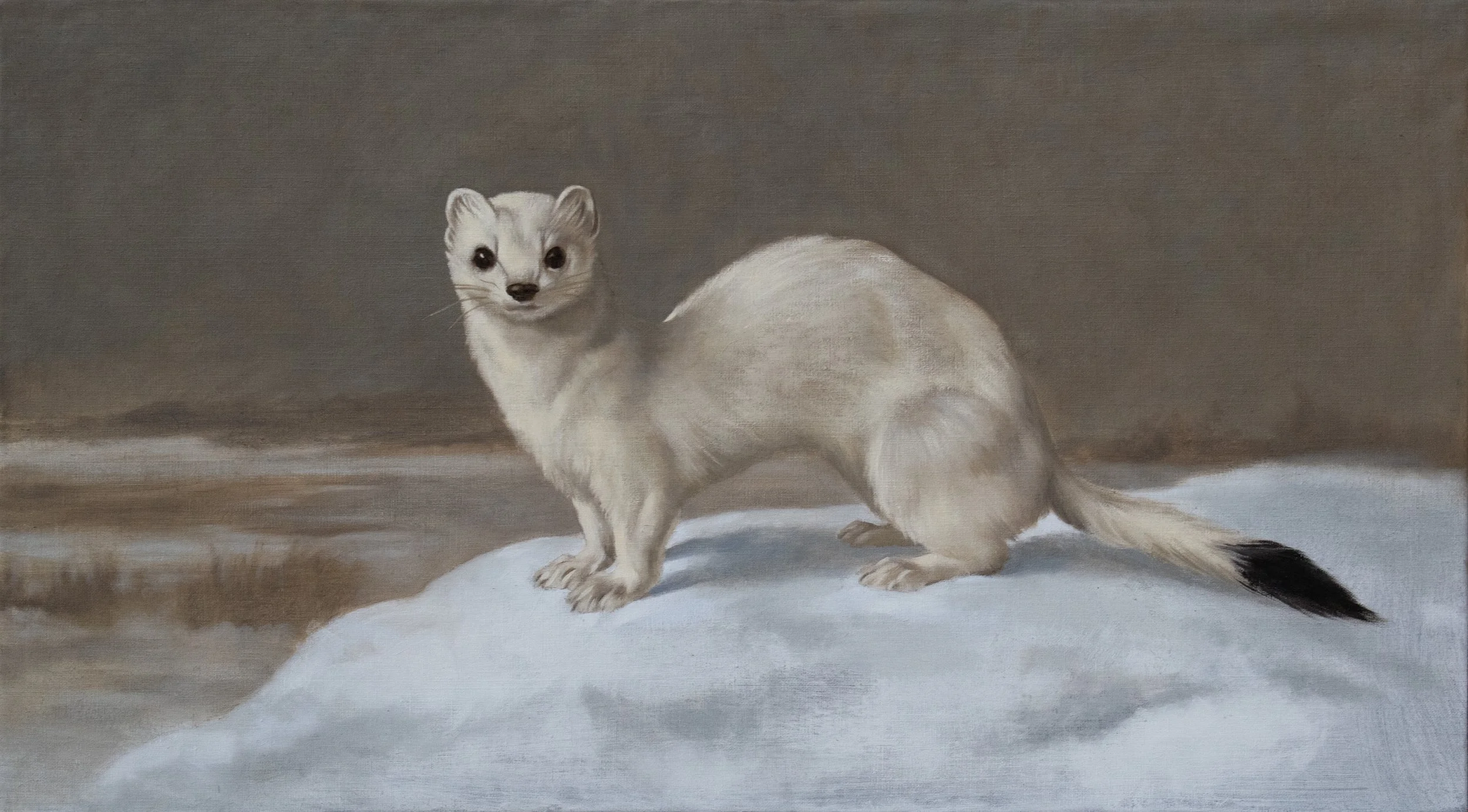
 Image 1 of 2
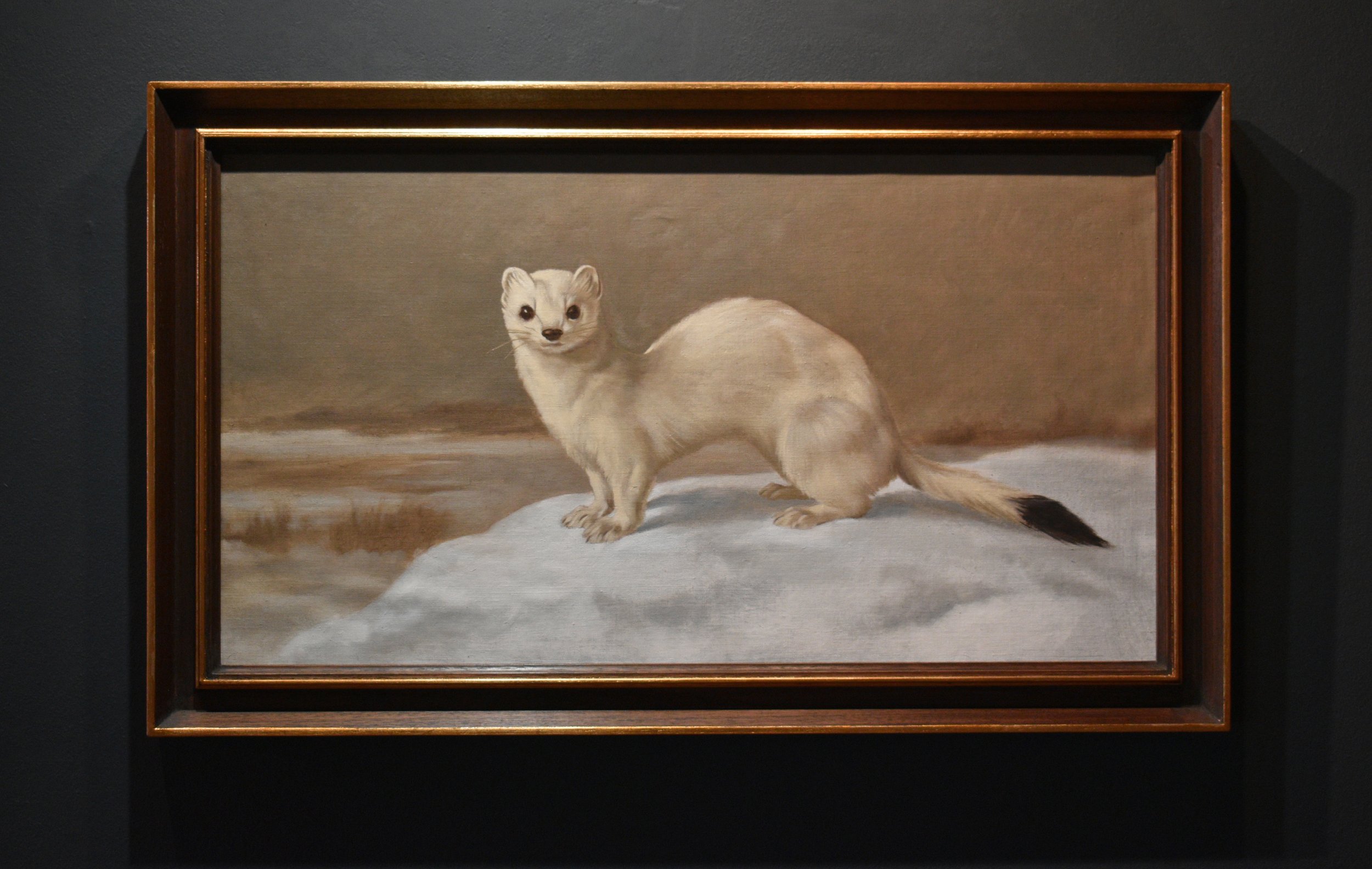 Image 2 of 2
61 x 34cm (framed size: 69 × 42cm)
Oil on Linen
Bespoke Frame by Artisan Framing of Shaftesbury
2026
Moving to a smaller scale (from first Stalking Horse then Blackbuck and White Hart) I wanted a pair of creatures that had a fiercely compact density, and I happened to be listening to the audiobook of Gorky Park by Martin Cruz Smith. The story’s McGuffin/ plot device is centred in the illicit trade in Sables which also serve as the emblem of an untameable Russian nature.
The trade in animal pelts underpinned the colonization and spread west and north of what became British North America under the aegis of the Hudson Bay Company. The Tsarist Russian Empire advanced east, reaching the Pacific in 1639 and as it did so it exhausted the ‘soft gold’ of prime sables. In the nineteenth century Russia expanded still further to Alaska in search of more.
The pelt of the Ermine’s status as symbol of purity and wealth and thus Royalty has its’ roots in the medieval period, indeed its’ extreme rarity and cost lead to its’ use being formally reserved for the highest nobility throughout Europe through various Sumptuary Laws and Act of Apparel (several of these acts also forbade the use of Sable)
‘Sable’ as I have considered and presented it thus a depiction of it a specific emblem of the East and ‘Ermine’ particularly that of the West.
Expansionist policies were driven East and West in search of this ‘soft gold’ and it functioned a key driver of and precurser to resource driven conflicts, leading to definitions of boundaries, and a long history of an arms race resulting in the Cold War – the repercussion of which we still live with.
As Maxim Gorky’s famous aphorism states, ‘Man, in changing nature, changes himself’
61 x 34cm (framed size: 69 × 42cm)
Oil on Linen
Bespoke Frame by Artisan Framing of Shaftesbury
2026
Moving to a smaller scale (from first Stalking Horse then Blackbuck and White Hart) I wanted a pair of creatures that had a fiercely compact density, and I happened to be listening to the audiobook of Gorky Park by Martin Cruz Smith. The story’s McGuffin/ plot device is centred in the illicit trade in Sables which also serve as the emblem of an untameable Russian nature.
The trade in animal pelts underpinned the colonization and spread west and north of what became British North America under the aegis of the Hudson Bay Company. The Tsarist Russian Empire advanced east, reaching the Pacific in 1639 and as it did so it exhausted the ‘soft gold’ of prime sables. In the nineteenth century Russia expanded still further to Alaska in search of more.
The pelt of the Ermine’s status as symbol of purity and wealth and thus Royalty has its’ roots in the medieval period, indeed its’ extreme rarity and cost lead to its’ use being formally reserved for the highest nobility throughout Europe through various Sumptuary Laws and Act of Apparel (several of these acts also forbade the use of Sable)
‘Sable’ as I have considered and presented it thus a depiction of it a specific emblem of the East and ‘Ermine’ particularly that of the West.
Expansionist policies were driven East and West in search of this ‘soft gold’ and it functioned a key driver of and precurser to resource driven conflicts, leading to definitions of boundaries, and a long history of an arms race resulting in the Cold War – the repercussion of which we still live with.
As Maxim Gorky’s famous aphorism states, ‘Man, in changing nature, changes himself’